Greece tours are day trips, boat trips and walks with tour leaders across the Greek mainland and islands. They set out from Athens, from the island ports and from the cruise terminals.
The sections below follow the main tour areas: Athens and the Acropolis, the Peloponnese and central Greece, the Saronic and Cyclades islands, Crete, Rhodes, the Ionian Sea and the north. Food and wine, the seasons and common questions close the page. A bookable tour sits at the end of each area.
What are Greece tours?
Greece tours mean planned trips that take visitors across the Greek mainland and islands with a tour leader. They link ancient sites, island coasts, mountain trails and marinas into one route. Expert-led groups handle transport, entry and the story behind each stop.
The country is largely mountainous, with a very long coastline full of peninsulas and islands. It spans latitudes from 35°N to 42°N and longitudes from 19°E to 28°E. One count puts the number of Greek islands at 9,841. Only 169 of them have continuous human presence. Greece tours pick routes from this wide map.
Greece’s largest islands are Crete, Euboea, Lesvos, Rhodes, Chios, Kefalonia and Corfu. The Aegean islands fall into seven traditional groups, listed from north to south. The Sporades group alone holds 30 islands, with four counted as the major ones. Island-hopping tours in Greece use these groups to plan a clear path between ports.
Mass tourism in modern Greece began to flourish in the 1960s and 1970s. In 2023, tourism earned the country about €19.7 billion, around 11% of total GDP. Jobs linked directly or indirectly to tourism reached 659,719. That figure equals 16.5% of total employment. Germany was the leading tourist market that year, with about 4.7 million visitors.
- Heritage: Archaeological sites are dotted all around Greece, and a large number draw tourists.
- UNESCO: In 1988, UNESCO put five Greek sites on its World Heritage List.
- Nature: Greece has become an ecotourism destination for hiking, canoeing, caving and climbing.
- Sailing: Greece has 51 marinas with 14,661 mooring places offering berths, fuel, water and repairs.
Greece welcomed over 19.3 million tourists in 2009, up from 17.7 million in 2008. The Alimos and Flisvos marinas on Athens’ south coast hold over 1,800 vessels. Greek tours draw on this mix of sea, ruins and mountain trails.
Which Greece tours visit the Acropolis of Athens?
Greece tours that include Athens visit the Acropolis, a fortified hill sacred to Athena. Small-group and escorted visits pass the Propylaea gateway, the Erechtheion and the Athena Nike temple. Expert-led routes reach the Theatre of Dionysus and the Acropolis Museum.
The Acropolis hill is rocky and steep on every side except the west. Its top is nearly flat. Strong fortification walls have ringed the summit for more than 3,300 years. In the 8th century BC, the hill slowly took on a religious role with the cult of Athena. Greece tours explain this long story on site.
The Propylaea had coffered ceilings with golden stars on a blue field, or an arrangement of palmettes. In the 10th century AD, its central section became a church of the Taxiarches. UNESCO dates the Temple of Athena Nike, the work of Mnesikles and Kallikrates, to 427-424 BC. Its columns follow a 7:1 height-to-diameter ratio.
The Erechtheion had gilded capitals, and coloured glass studded the braids at its column bases. An altar to Zeus Hypatos stood on its east porch, just before the temple door. The monuments have survived almost 25 centuries of wars, explosions, bombardments, fires and earthquakes. Restoration work seen on Greece tours follows the principles of the Venice Charter.
- Theatre seats: Seats in the Theatre of Dionysus measured 33 cm deep and 33 cm high, with a lip.
- Seats of honour: The theatre once had 67 seats of honour, and each surviving one names a priest or official.
- Orchestra barrier: A marble barrier, built in 61 AD or later, enclosed the orchestra up to the side passages.
The Acropolis Museum is the largest modern building raised so close to the ancient site. Elton John played two concerts at the Odeon of Herodes Atticus in 2000. Greece tours pairing the hill with the museum cover the ruins and their modern neighbour.
Which Greece tours go from Athens to Mycenae, Epidaurus and Sounion?
Greece tours from Athens link the Mycenaean sites of Mycenae and Tiryns with Epidaurus and Nafplio. Other routes run south to Sounion and its Temple of Poseidon. Escorted groups see grand tombs, huge stone walls, a healing sanctuary and an ancient theatre.
At Mycenae, Greece tours stop at the Treasury of Atreus. Its entrance facade stands 10.5 m high. Wace estimated the passage masonry at over 600 cubic metres and 1,200 tons. Tour leaders also tell the story of Heinrich Schliemann. He later named his own son after the legendary King Agamemnon.
The Tomb of Clytemnestra was built around 1250 BC. It was the last tomb of its type in the region. Gypsum half-columns frame its entrance facade, carved with ornate capitals and vertical fluting. In Mycenaean Cyclopean walls, builders used cut stone only in and around gateways. At Mycenae, that stone was conglomerate.
Greece tours then continue to Epidaurus. UNESCO calls its Sanctuary of Asklepios the earliest organized sanatorium. UNESCO also ranks the theatre high among known ancient theatres for authentic form and material. The stadium keeps almost 90% of its ancient form and material. Since 1984 the sanctuary has been a zone of absolute protection, with no building allowed.
- Tiryns: Its fortification, finished at the end of the 13th century BC, runs about 750 m around.
- Nafplio: The town seems to appear as Nuplija on an Egyptian funerary inscription of Amenophis III.
- Diolkos: It let ships avoid Peloponnese headlands, especially Cape Matapan and Cape Malea, known for gales.
- Corinth Canal: After the Axis occupation of Greece, Allied attempts to block the canal did not succeed.
Greece tours to Sounion head to the southernmost part of Attica. The deme of Sounion lies about 13 kilometres south of Thorikos. Offerings found at the Temple of Poseidon suggest that elite and aristocratic visitors frequented the site.
What do Greece tours to Delphi and Meteora show?
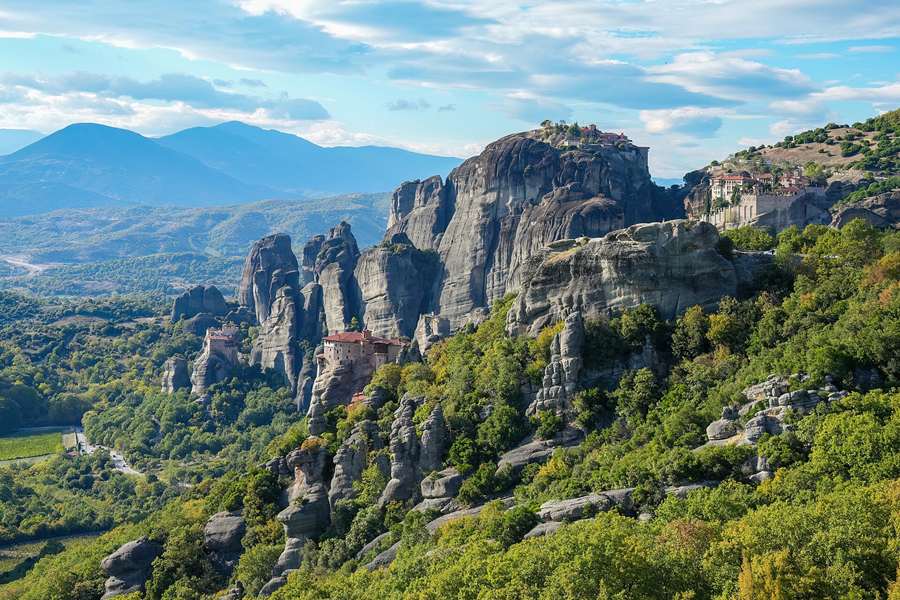
Greece tours to Delphi show Apollo’s temple site, the Phaedriades cliffs and the Charioteer in the museum. At Meteora, the tours show monasteries on tall cliffs, still home to small communities. Theopetra Cave adds one more stop along the way.
Greece tours to Delphi open with the setting. Strabo, Plutarch and Pausanias all mentioned the Phaedriades cliffs when they described Delphi. The site lies near the great tectonic fault of Central Greece. Earthquakes and landslides have hit it since ancient times. Two metal fences now give temporary protection against falling rocks.
The omphalos stone seems to have been oval and decorated in high relief. Pausanias described mermaid-shaped precious stones in its wool wrapping. He also described two gilded eagles on top. Apollo’s temple held an iron chair dedicated to the poet Pindar. Pliny the Elder credits the paintings on the walls of the temple cella to Aristoclides.
Meteora is a different kind of stop on Greece tours of the mainland. It appears in neither classical Greek myths nor ancient Greek literature. The sediments of its cliffs once lay in an inland sea during the Pliocene epoch. Today each still-functioning monastery houses under ten people.
- Charioteer of Delphi: Soft side-curls on the statue show that it depicts a young man.
- Delphi museum: Construction of a new Delphi Archaeological Museum building began in 1935.
- Meteora museums: At Meteora, restoration work has converted other monastery buildings into museums.
- Theopetra Cave: Its limestone rock formed in the Upper Cretaceous period, 135–65 million years ago.
Greece tours to Meteora are part of a busy local trade. Tourism is the main local source of income at Meteora, with about 200,000 visitors a year. Cliffs that no ancient poet described now draw these crowds.
Which Greece tours sail to Hydra, Poros and Aegina?
Greece tours to these three islands start at the port of Piraeus. Stops cover early finds on Hydra and the Kalaureia sanctuary on Poros. Aegina adds the temple at Aphaia and wide pistachio farms. Each island shows a different layer of the past.
Piraeus ranks as the 24th largest passenger port in the world. On Hydra’s Mount Chorissa, finds include vase pieces, tools and the head of an idol. Obsidian from Milos has also been found there. Around the 12th century BCE, the Dorian invasion appears to have emptied the island of people.
Greece tours on Poros visit the Kalaureia sanctuary. Strong evidence shows Poseidon there bore the title Geraistos. The word comes from an unknown pre-Hellenic language. Stoa A at the site was a Doric building. Its polygonal walls were covered in red plaster. A third-century BCE plaque found there celebrates the revival of the Kalaureian League.
Pistachio growing covers an estimated 29,000 acres of Aegina. Greece tours there also reach the sanctuary of Aphaia. The German School in Athens dug there, first under Adolf Furtwängler. In 1969, Dieter Ohly found substantial remains of an older Archaic temple inside later terrace walls. A 14 m column topped by a sphinx stood on its northeast side.
- Aegina colonies: Unlike Corinth, Chalcis, Eretria and Miletus, Aegina did not found any colonies.
- Aphaia decline: The sanctuary declined rapidly after Athens took control of Aegina in the mid-fifth century BC.
- Aegina: Greece tours pair the Aphaia sanctuary with the pistachio groves across the island.
Poros keeps the memory of an old Russian naval base. By the early 20th century, only a single Russian watchman guarded it. Aegina’s Archaic fleet used Kydonia as an ideal stop toward other Mediterranean ports. Greece tours across the Saronic Gulf link these island stories in one sailing.
What do Greece tours on Santorini include?
Greece tours on Santorini include a boat stop at Palea Kameni and a walk through Akrotiri. Tour leaders also explain the Minoan eruption. The Museum of Prehistoric Thera adds fossils of plants that grew before people lived on Thera.
Greece tours by boat sail to Palea Kameni, a private island. People lived there until it was bought in 1899. The island was later sold in 1975. On board, tour leaders turn to the Minoan eruption. Tree rings show unusual growth in 1597, 1560, 1546 and 1544 BC. That pattern fits a major volcanic event.
Distant records hint at the eruption. China’s Bamboo Annals report yellow skies and summer frost, possibly from its volcanic winter. The Egyptian Ahmose Tempest Stele records an extraordinary cataclysm that resembles it. Estimates put the sulfur from the Minoan magma at 0.3 to 35.9 trillion grams. Ash found on Crete came from an early, precursory phase.
Greece tours on land head to Akrotiri, a buried prehistoric city. Within hours of Marinatos starting his dig, remains began to appear. Severe earthquakes forced its people to abandon the town in the last quarter of the 17th century BC. The final port in the Flotilla frieze is identified as Akrotiri itself.
- Xeste 4: Its large size, exterior and wall paintings point to a public building.
- House of the Ladies: Named after a fresco of Ladies and Papyruses, it has a central light-well.
- West House: One room had walls painted with a single motif repeated eight times.
- Nile Delta: Claims of Santorini ash found there are now known to be a misidentification.
Wall paintings in Xeste 4 showed life-size male figures climbing its entrance staircase in procession. Greece tours on Santorini set these scenes beside the eruption records. Together, the streets, houses and paintings show how prehistoric Thera looked.
Which Greece tours cover Mykonos and Delos?
Greece tours to the central Aegean link Mykonos with the small island of Delos. Travellers once had to stop on Mykonos before visiting Delos. Today the Delos site receives over 100,000 visitors every year. Expert-led walks explain its ancient sanctuary and ruins.
Delos is a small, rocky island of 350.64 hectares in the centre of the Aegean Sea. Its sanctuary of Apollo goes back to the 9th century BC or earlier. No later village or town ever rose on top of the old ruins. So Greece tours here walk among ruins with no modern houses above them.
The feast of the Delians took place every four years until 316 BC. It had athletic, horse-riding and music contests, plus dances, plays and banquets. Like the Olympic and Pythic Games, it was a major event in the Greek world. Tour leaders share this story as groups stand inside the old sanctuary.
Greece tours to Delos also cover its old port. In the 2nd century BC, about 25,000 people lived there. Pirates who entered the port took on the status of merchants. Later, Delos was the seat of the bishopric of the Cyclades. Today archaeologists, conservators, architects and antiquity guards live there all year.
- Panagia Paraportiani: This Mykonos landmark stands as one of the best-known buildings in Greece.
- Windmills: Windmills dot the island of Mykonos, and the main town of Chora holds the largest share.
- Beehive tomb: Finds on Mykonos include a beehive tomb of the mainland Mycenaean type.
- Delian mosaics: A three-colour diamond pattern in Delos mosaics tricks the eye into seeing cubes in perspective.
Greece tours that join Mykonos and Delos follow the same order as travellers in the past. Mykonos comes first, with its windmills in Chora. Delos follows, with ruins that no later town ever covered. Together the two islands show a long slice of Aegean history.
What do Greece tours on Milos visit?
Greece tours on Milos visit the white cliffs of Sarakiniko and the catacombs at Trypiti. They also tell the story of the Venus de Milo, now in the Louvre. The island’s past runs from obsidian tools to pirates and millstones sent to France.
Sarakiniko is a landscape of snow-white cliffs, turquoise water and strange rock shapes. The catacombs at Trypiti have no match elsewhere in the Aegean or in Greece. In ancient times, the caves around Trypiti served as family burial chambers. Greece tours pair both places to show the island’s wild nature and its deep past.
Greece tours explain the obsidian trade. Milos was the principal source of obsidian, a stone used for tools. It acted as a redistribution point for the archipelago. Obsidian stayed the main tool material even after metalworking began, because it cost less. Milos lost its role in making arms once bronze became the preferred material for weapons.
Pottery from Phylakopi shows that trade routes from mainland Greece to Crete passed the Western Cyclades. Milos sent its millstones as far away as France. Pirates spent the winter, from December to March, on Milos, Paros, Antiparos or Ios. In the late 17th century, Milos made its living from these wintering pirates.
- The find: Testimony from Dumont d’Urville says the Venus de Milo was found in a four-sided niche.
- The purchase: After the French stepped in, the Comte de Marcellus was able to buy the Venus.
- The Louvre: King Louis XVIII had the statue placed in the Louvre once it reached France.
- Missing parts: Besides both arms, the Venus de Milo also lacks its left foot and earlobes.
The Venus de Milo left France only once, for shows in Tokyo and Kyoto in 1964. Kenneth Clark called it “the last great work of antique Greece”. Greece tours on Milos keep its story alive on the island where it was found.
Which Greece tours explore Chania and western Crete?
Greece tours in western Crete pair Venetian Chania with the wild Lefka Ori. Walkers follow the Samaria Gorge, cross the Omalos Plateau and visit ancient Falasarna. Each stop links old fortresses, rare plants and ancient sites in one region.
Chania’s Venetian walls formed a rectangle with four heart-shaped bastions and four cavaliers. The defences also took in a round harbour tower. The Genoese built that tower in the early 13th century. Walking Greece tours pass the Firkas Fortress, once the seat of the city’s military governor. In 1630 the city was armed with 319 cannons and 30,695 cannonballs.
The Venetian harbour breakwater carried the bastion of San Nicolò del Molo. At its tip stood a small lighthouse tower. That tower was lower than today’s lighthouse, built after 1830. Ancient Kydonia lies within urban Chania. The full extent of this archaeological site is not yet determined. Greece tours in the city link both eras.
The Lefka Ori are the largest and westernmost mountain range on Crete. A total of 174 endemic Greek taxa are found in this area. Almost half the plant species of the Lefka Ori High Desert are found nowhere else. Fossils on the vertical walls of the Samaria Gorge reveal its geological history.
- Ancient Kaino: This site inside the Samaria Gorge was considered the birthplace of the goddess Britomartis.
- Early settlers: Recent finds suggest Paleolithic humans settled the area of the Samaria Gorge.
- Omalos Plateau: Greece tours cross this plateau, which was used as an airfield during World War II.
- Falasarna: A treaty with Polyrrhenia shows its people engaged in piracy in the third century BC.
Tarra, the Samaria Gorge and the Omalos Plateau form a designated Area of Exceptional Natural Beauty. Greece tours here mix town walks with mountain hikes. The route runs from Venetian harbour stones to signs of Paleolithic settlers and rare plants.
What do Greece tours in central and eastern Crete visit?
Greece tours in central and eastern Crete visit Knossos and the Heraklion museum. Routes then head to Spinalonga, ancient Lato and the Minoan building at Zominthos. Each stop shows a different chapter of island history, from Minoan halls to the Cretan War.
At Knossos, the House of the High Priest holds a stone altar framed by double-axe bases. The South Mansion is a three-storeyed house with a lustral basin and a pillared crypt. The rectangular Unexplored Mansion has a central four-pillared hall, corridors and storerooms. Under Roman rule the city became known as Colonia Iulia Nobilis Cnossus.
The Heraklion museum’s ground floor shows seafaring Minoan power and Crete’s first urban centres. One standout is the bronze Arkalochori double axe, known for its large size and fifteen inscribed symbols. During the Second World War, Professor Nikolaos Platon saved the museum’s antiquities. Greece tours pair this visit with Knossos.
In the Cretan War, rebels called Chainides used Spinalonga as a base against the Ottomans. Its surviving two-storey houses and shops follow local and Balkan architectural tradition. Ancient Lato is possibly named RA-TO in the Linear B tablets. Before the end of the 3rd century BC, Lato joined the League of the Cretan cities.
- Zominthos: In 1982 Yannis Sakellarakis uncovered a large two-storey Minoan building here, just below 1,200 m.
- Room count: The Zominthos building has more than 100 rooms on its ground floor alone.
- Museum wing: In 1912 Wilhelm Dorpfeld and Panagis Kavvadias designed a Neoclassical west wing for the early museum.
- Deep past: About 25 million years ago, Crete and mainland Greece formed one land mass called Ägäis.
Crete’s separate geological history began after the Messinian Salinity Crisis, about 5.3 million years ago. Greece tours across the island show what came much later. Mansions, museum halls and rebel bases tell that human story stop by stop.
Which Greece tours run on Rhodes and Lindos?
Greece tours on Rhodes walk the walled town of the Knights and hear the Colossus story. They also visit the Athena sanctuary at Lindos. Small-group tour leaders link each stop to sieges, earthquakes and old myths of the island.
In 1480 Mehmed II attacked Rhodes with 100,000 troops and 170 ships. The Knights drove the attack back. In 1481 a destructive earthquake struck the island. It damaged houses and walls, with about 30,000 casualties. In 1522 the Ottomans dug tunnels under the moat. The aim was to undermine the Rhodes terrepleins.
Escorted Greece tours stop at the Inn of Auvergne. Its facade bears the arms of Guy de Blanchefort, Grand Master from 1512 to 1513. At the Amboise Gate section, the curtain wall carried a 4 m-high parapet pierced with gun holes. A recent study places foundations of the temple of Helios where the Grand Master’s Palace stands.
Greece tours on Rhodes also tell the Colossus story. The Suda says Rhodians were called Colossaeans for erecting the statue on their island. Eight forged iron bars in a radiating horizontal position formed its ankles. Pliny the Elder wrote of the fallen statue’s thumb. Only a small number of men were able to wrap their arms around it.
- Lindos: Italian archaeologists Maiuri and Jacopi excavated the Athena sanctuary there between 1910 and 1932.
- Ritual: The Rhodian cult of Athena required burning the entrails of sacrificial animals on the altar.
- Myth: Gold rained on Rhodes, the story says, when Athena was born from the head of Zeus.
- Grand Master: Pope Adrian VI proclaimed Philippe Villiers de L’Isle-Adam a Defender of the Faith.
Rhodes lies on the unstable Hellenic arc. Because of this, the island has two serious earthquakes per century. Greece tours on Rhodes pair that restless ground with tales of knights, sieges, gods and a fallen statue. Lindos adds the Athena sanctuary dig.
What do Greece tours in the Ionian Islands include?
Greece tours in the Ionian Islands take in Corfu’s old town, its forts and the Achilleion. On Zakynthos they reach Navagio and the loggerhead turtle park. On Kefalonia they stop at Myrtos, a mile-and-a-half arc of white pebbles shaped by the sea.
UNESCO notes Corfu’s urban and port ensemble for its high level of integrity and authenticity. Greece tours in Corfu City visit the Venetian Citadel. Corfu’s Catholic community of about 4,000 lives almost entirely inside it. In 1537 only the Old Fort and Angelokastro castle stayed out of the invaders’ hands.
Tour leaders tell of the 1718 explosion. Venetian fortress commander Captain Andrea Pisani and members of his staff died in it. The Achilleion is another stop for Greece tours on Corfu. Empress Elisabeth built it and was assassinated in Geneva in September 1898. Much of its interior was later moved back to Vienna.
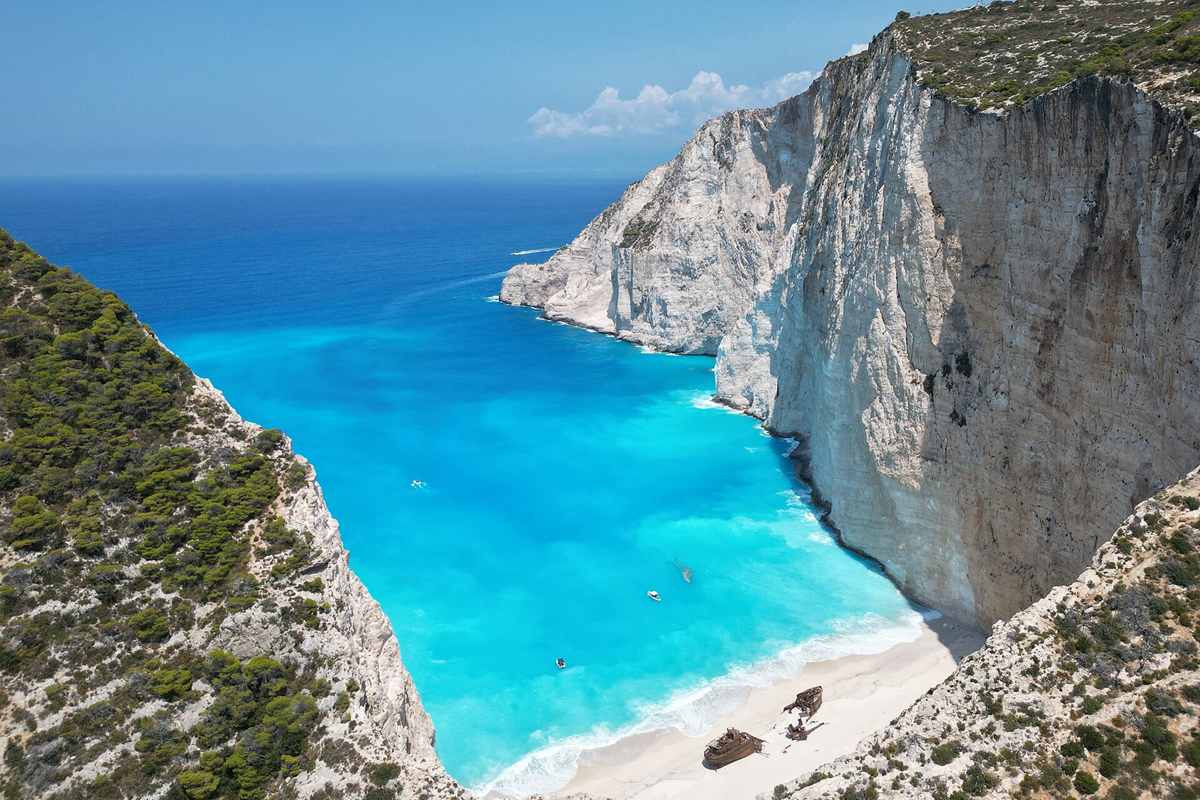
On Zakynthos, Greece tours head to Navagio, where the wreck lies, on the north-western side. The spot draws thousands of visitors each year. The island’s park is home to the loggerhead turtle. It is seen as one of the oldest life forms on the planet. Females return to lay eggs on or near the beach where they hatched.
- Turtles: A single loggerhead clutch of eggs can have up to seven fathers.
- Myrtos: Longshore drift and wave energy have shaped this Kefalonia shore of white pebbles.
- Greek fir: This tree grows on mountains with a rainfall of over 1,000 millimetres.
Greece tours across the Ionian Islands mix forts, imperial history and wild coast. Corfu holds the Venetian Citadel, the Old Fort and the Achilleion. Zakynthos adds Navagio and its turtles. Kefalonia offers Myrtos, a mile-and-a-half curve of white pebbles.
Which Greece tours explore northern Greece?
Greece tours in the north start in Thessaloniki. From there, small-group routes visit the royal tombs at Vergina, the Edessa waterfalls and the Pozar thermal baths. Others head for the Halkidiki peninsula, the monasteries of Mount Athos and the slopes of Mount Olympus.
Greece tours of Thessaloniki start at the White Tower. In the 16th century, it was called the Lions Tower. Until 1917, a wall at its foot carried the heavy guns. The Arch of Galerius had a central opening 9.7 m wide and 12.5 m high. The Church of Hagios Demetrios was consecrated again in 1949, after a long restoration.
Escorted tours also stop at Vergina, next to the site of ancient Aigai. Before the discoveries at Vergina, Edessa was thought to be the site of Aigai. In March 2014, archaeologists found five more royal tombs at Vergina. Greece tours here visit the ground that settled that question.
Greece tours heading inland visit the town of Edessa and its waterfalls. Seleucus I Nicator named Edessa in Mesopotamia after this Macedonian town. The same route takes in the Pozar thermal baths. They are a popular tourist attraction in the cooler months.
- Halkidiki: Under Ottoman rule, the Chalkidiki peninsula was important for its gold mining.
- Mount Athos: In 17 of the Mount Athos monasteries, the monks are mainly ethnic Greek.
- Mount Olympus: Olympus National Park covers a protected area of 39.88 km² on the mountain.
- Olympus slopes: Limestone on Mount Olympus absorbs the rain, which makes the local climate drier.
Northern Greece tours join city history, royal tombs, waterfalls and a national park on one route. Byzantine chroniclers even wrote that the 726 eruption of Thera was visible from Mount Athos. A tour leader brings these old stories to life at each stop.
Which Greece tours focus on Greek food and wine?
Greece tours built around food and wine visit olive groves, feta dairies and Kalamata olive farms. Others head to the mastic villages of Chios. Tastings cover Greek wines, retsina and ouzo. In Athens, food walks pass through the central market, the Varvakios Agora.
Olive oil leads the tastings on Greek food tours. Italy, Greece and Turkey together hold 59% of the global olive oil market. That share makes olive groves a natural first stop on Greece tours of the countryside. Kalamata olives follow, named after the city of Kalamata in the southern Peloponnese.
Greece tours with farm visits show how feta is made. The cheese matures in a 7% salt brine for weeks. Then it spends at least 2 more months chilled. The word feta became the cheese’s common name only in the 19th century. Visitors then taste the finished cheese.
Greece tours for wine lovers compare grapes from different regions. Good Naousa Xinomavro can resemble Nebbiolo wines and draws comparisons with Italy’s Barolo. Xinomavro also grows, on a smaller scale, on Mount Athos. Agiorgitiko, unlike Beaujolais Nouveau, ages well for about five years. The Lagorthi grape grows mainly on high Peloponnese slopes of 850 metres.
- Chios mastic: The Chios Mastic Museum opened in Rachi, in the mastic villages, on 11 June 2016.
- Retsina: Modern retsina lacks the strong “whiff of turpentine” that older styles carried.
- Ouzo: Ouzo tastes similar to absinthe, licorice-like but smoother on the tongue.
Food walks in Athens end at the central market, the Varvakios Agora. In 1860, the Varvakeion school opened on a site across from today’s market. Greece tours that finish here let travellers shop for the foods they tasted along the way.
When do Greece tours run best during the year?
Greece tours run in every season, and each one brings something different. Summer brings warm seas and busy island airports. The cooler months bring mild seas and the majority of the rain. Easter and the month of August bring church feasts.
Summer is the busy season for Greece tours. Heraklion, Rhodes and Corfu airports serve as key tourist hubs in these months. Mediterranean waters turn warm. On Kastellorizo, the number of tropical nights can climb close to 160.
The cooler months bring the majority of the rain. Snow falls every year in the mountains and the north. Brief snowy spells can reach even Athens. From 1915 to 1929, the southeast tip of Lasithi averaged only 207.1 mm of rain a year. Mediterranean waters stay mild through winter.
The church calendar adds its own events. The Orthodox Easter service begins late on Saturday evening. On Syros, Catholics and Orthodox celebrate Easter on a common date, the Orthodox one. On August 1, the Procession of the Cross brings an outdoor procession and a water blessing.
- August 15: The Dormition feast falls on this date, set by an edict of Emperor Maurice.
- Dormition Fast: Greek churches hold a Paraklesis every evening, except Saturday and two feast eves.
- Santorini flights: Seasonal scheduled and charter flights arrive in spring, summer and autumn.
- Mykonos flights: The airport offers limited flight connections during the off-peak tourist season.
Each season gives Greece tours a different character. Summer brings warm water and busy airport hubs on the islands. The cooler months bring mild seas, rain and snow in the mountains. Below 500–1,000 m, Aegean bottom water keeps a very uniform 13–14 °C.
What do travellers ask about Greece tours?
Greece tours bring up four practical questions. Travellers ask about future UNESCO sites, island links, main airports, and the local language and money. Ferries remain the prominent way between islands. Greece has sixteen civil international airports, and the drachma is no longer legal tender.
Which future UNESCO sites can Greece tours visit?
Greece tours can reach sites on Greece’s UNESCO tentative list. The archaeological site of Nikopolis is one. Ancient Messene, another archaeological site, is listed too. The Ancient Towers of the Aegean Sea also appear on it. Greece held World Heritage Committee mandates in 1985–1991 and 1997–2003.
How do Greece tours reach the Greek islands?
Greece has the longest coastline in the Mediterranean basin, spanning thousands of islands. Ferries remain the prominent way to travel between them. In the Cyclades, Santorini is one of a small number of islands with a major airport. Mykonos airport flies to domestic and European metropolitan destinations.
Which airports serve Greece tours?
The two biggest civil international airports are in Athens and Thessaloniki. Thessaloniki airport opened to civilian traffic in 1948, after a wartime pause in building. NATO funds expanded its runway to 2,440 metres and opened a new terminal in 1965. Heraklion airport received its first charter flight from abroad on 18 March 1971.
Which language and currency do Greece tours use?
At least 13.5 million people speak Greek, in Greece, Cyprus, Italy, Albania, Turkey and the diaspora. In 1976 Greece declared Dimotiki its official language, giving birth to Standard Modern Greek. Greece joined the EU’s Economic and Monetary Union in June 2000. The drachma has not been legal tender since 1 March 2002.